
Tech Partnership: An Intriguing Alternative to Hiring In-House Developers

As a Business Development Executive, I have witnessed firsthand the evolving landscape of the tech industry. Companies are constantly searching for innovative ways to stay competitive, and one of the most significant decisions they face is whether to hire in-house developers or seek alternative solutions. In this context, tech partnerships have emerged as a compelling alternative to traditional in-house development teams. Here’s why tech partnerships are worth considering:

  1. Access to a Broader Talent Pool

One of the primary advantages of tech partnerships is access to a vast, diverse talent pool. In-house hiring often limits you to local or regional talent, which may not always meet the specific needs of your projects. Tech partnerships, on the other hand, allow you to tap into a global network of developers with specialized skills and experiences. This not only enhances the quality of your projects but also introduces fresh perspectives and innovative solutions.

  1. Cost Efficiency

Hiring in-house developers comes with significant costs, including salaries, benefits, office space, and training. These expenses can quickly add up, especially for small and medium-sized enterprises. Tech partnerships offer a more cost-effective solution by allowing companies to scale their development teams based on project needs. You only pay for the services you use, which can result in substantial savings without compromising on quality.

  1. Flexibility and Scalability

The ability to scale your development team up or down based on project requirements is a crucial advantage of tech partnerships. In-house teams are often fixed in size, making it challenging to adjust to varying workloads. Tech partnerships provide the flexibility to quickly add or reduce resources as needed, ensuring that your projects remain on track and within budget.

  1. Focus on Core Business Activities

Managing an in-house development team requires significant time and effort, from recruitment and training to daily supervision. This can divert attention from your core business activities. By partnering with a tech firm, you can offload the complexities of development management, allowing your team to focus on strategic initiatives and business growth.

  1. Access to Latest Technologies and Best Practices

Tech partners are often at the forefront of technological advancements, continuously updating their skills and adopting the latest industry practices. Partnering with such firms ensures that your projects benefit from cutting-edge technologies and methodologies. This can give your business a competitive edge, ensuring that your products and services remain relevant and innovative.

  1. Risk Mitigation

Tech partnerships can also help mitigate risks associated with development projects. Established tech firms have robust processes and quality assurance measures in place, reducing the likelihood of errors and delays. Additionally, many tech partners offer contractual guarantees and service-level agreements (SLAs), providing security and peace of mind.

  1. Rapid Time-to-Market

In today’s fast-paced market, speed is of the essence. Tech partnerships can accelerate your time-to-market by leveraging the expertise and resources of your partner firm. Their experience managing similar projects can streamline development processes, resulting in quicker delivery times and a faster realization of business value.

  1. Enhanced Innovation and Collaboration

Collaboration with a tech partner can foster a culture of innovation within your organization. Exposure to different working styles and innovative solutions can inspire your team to think creatively and explore new ideas. This collaborative environment can lead to breakthrough innovations that set your business apart.

In conclusion, tech partnerships offer a compelling alternative to hiring in-house developers. They provide access to a diverse talent pool, cost efficiency, flexibility, and the latest technologies, all while allowing your team to focus on core business activities. By mitigating risks and accelerating time-to-market, tech partnerships can drive your business toward greater innovation and success.

As a business development executive, I have seen the transformative impact that tech partnerships can have on businesses. By embracing this model, companies can unlock new opportunities, enhance their competitive edge, and achieve their strategic goals more effectively. If you’re looking to propel your business forward, it might be time to consider the power of tech partnerships.

– Neha Sonar
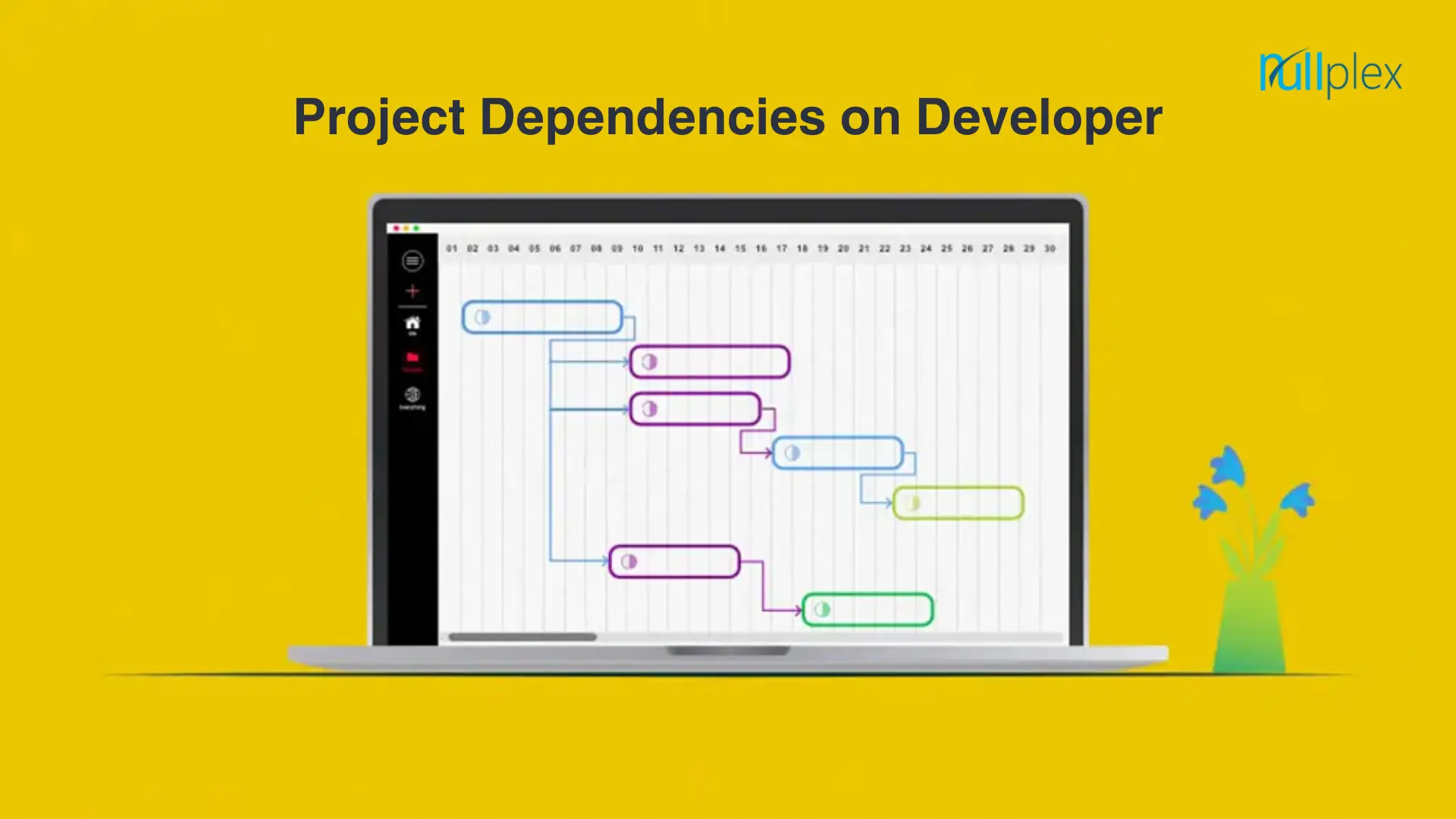
Developer Dependency: A Key Element in Project Execution

Project dependencies refer to the relationships between tasks or activities within a project, where the completion or timing of one task depends on the completion of another.

Types of Project Dependencies

  1. Logical dependencies

Logical or causal dependencies are quintessential to project management and cannot be avoided as they are necessary for project completion.

Tasks with logical dependencies cannot be performed simultaneously. Without completing a preceding task, the succeeding task cannot be started.

Example – You cannot publish a blog on your website straight away. It has to be written, reviewed, and edited before it is ready to be published.

  1. Cross-team dependencies

Cross-team dependencies are commonly witnessed in large-scale organizations where teams from different departments work together to complete a single complex project. In this case, teams depend on each other to achieve a common goal i.e. timely project completion and delivery.

  1. Discretionary dependencies

Discretionary dependencies, also known as preferred or soft logic dependencies, are those that are at the discretion of project teams, other stakeholders, and best industrial practices. These are not necessary for project completion but can help improve the quality of project deliverables.

  1. Internal dependencies

Internal project dependencies are those that project teams have complete control over and there’s no dependence on outside parties. Internal dependencies are when two tasks or activities within the same project are dependent on each other and there’s no reference to external projects and activities.

Example – The Quality Analyst team is not in a position to test software until the development process is finished.

  1. External dependencies

Opposite to internal dependencies, external dependencies are those when project teams have no control over external factors and are not in a position to do anything to escalate the project’s progress.

Although most project activities are controlled by internal teams. Many external factors can affect the progress of the projects such as client approval, vendors, tools, and others.

Example – A project team cannot start working on a project until the client (external party) gives the go-ahead to the team. In this case, a project team is dependent on external parties i.e. client to start working on a project.

Task dependencies in project management :

Finish to Start (FtS)

This task dependency is the most prevalent. Task A must be finished before Task B can begin.

Finish to Finish (FtF)

Before Task A is finished, Task B cannot be finished. This frequently occurs with tasks that have subtasks.

Start to Start (StS)

Task B cannot begin until Task A begins under this model. These are for tasks that need to be completed concurrently.

Start to Finish (StF)

For Task A to be finished, Task B must begin. This is crucial in circumstances where there must be overlap.

Conclusion :

Also, weekly assigned tasks will make it easier for the reviewing party to provide feedback in a more timely manner.

Weekly goals will help you focus on little portions of the projects, minuscule tasks that can be mapped out beforehand according to their urgency and priority.

These goals will help the team focus more on the task at hand. Therefore, there is no chance that they would get overwhelmed by the pressure of the upcoming tasks.

Call, Apply, Bind – Understanding Basic Concepts of JavaScript

In programming languages, you have a this keyword. The “this” keyword lets you refer to an object from within that object. “this”‘s value will change depending on the context that “this” is called in. By default it refers to the global scope, but when called within a function, it refers to that function.

Note – To understand call, apply, and bind you need to have good knowledge of how “this” works in JavaScript.

call(), apply(), and bind() can refer “this” to object.

 This let’s you to change the context of this when you invoke the function. It depends on how we are invoking the function.

1) Call:

Call method takes input as an String args comma seperated. call() provides a new value of this to the function/method. With call(), you can write a method once and then inherit it in another object, without having to rewrite the method for the new object.

                ex –

                const commonMethods = {

    fullname : function(city,state){

        return this.fname + ” ” + this.lname + ” Lives in ” + city + ” – ” + state;

    }

                }

                const Hero_1 = {

                    fname : “Tony”,

                    lname : “Stark”

                };

                const Hero_2 = {

                    fname : “Steve”,

                    lname : “Rogers”

                }

                const Hero_1_Details = commonMethods.fullname.call(Hero_1,”Malibu Point”,”USA”);

                const Hero_2_Details = commonMethods.fullname.call(Hero_2,”Washington, D.C.”,”USA”);

                console.log(Hero_1_Details);

                console.log(Hero_2_Details);


2) Apply:

It is same as call but different in passing the arguments in. The apply() method calls the specified function with a given this value, and arguments provided as an array (or an array-like object). apply() accepts a single array of arguments — for example, func.apply(this, [‘eat’, ‘bananas’]);

                ex :

                                const commonMethods = {

    fullname : function(city,state){

        return this.fname + ” ” + this.lname + ” Lives in ” + city + ” – ” + state;

    }

                }

                const Hero_1 = {

                    fname : “Tony”,

                    lname : “Stark”

                };

                const Hero_2 = {

                    fname : “Steve”,

                    lname : “Rogers”

                }

                const Hero_1_Details = commonMethods.fullname.apply(Hero_1,[“Malibu Point”,”USA”]);

                const Hero_2_Details = commonMethods.fullname.apply(Hero_2,[“Washington, D.C.”,”USA”]);

                console.log(Hero_1_Details);

                console.log(Hero_2_Details);


3) Bind:

The bind() method creates a new function that, when called, has its this keyword set to the provided value, with a given sequence of arguments preceding any provided when the new function is called. With the bind() method, an object can borrow a method from another object.

                const Hero_1 = {

                    fname : “Tony”,

                    lname : “Stark”,

                    fullname : function(city,state){

                        return this.fname + ” ” + this.lname + ” Lives in ” + city + ” – ” + state;

                    }

                };

                const Hero_2 = {

                    fname : “Steve”,

                    lname : “Rogers”,

                    showSuperPower : function(power){

                        return `Super Power is ${power}`

                    }

                }

                // here we have interchanged the function of each other. (showSuperPower and fullname)

                const Hero_2_Details = Hero_1.fullname.bind(Hero_2);

                console.log(Hero_2_Details(“Washington, D.C.”,”USA”));

                // Or

                const Hero_1_Details = Hero_2.showSuperPower.bind(Hero_1);

                console.log(Hero_1.fullname(“Malibu Point”,”USA”) + ” – and ” +Hero_1_Details(“Can Fly”));


Pros of using call apply bind:

  1. Code duplication removed.
  2. We can create a new function and bind with existing.
  3. Readability improves.

Cons of using call apply bind:

Basic concepts of Scops and “this” keyword must be strong else find hard to read and debug

Conclusion:

From the article, we’ve explored the foundational concepts of JavaScript. We’ll be adding more articles soon to delve deeper into the subject.

Thank you for reading!

Career Hire Us
Request Callback

Got An Idea?

Let’s Build It.

Tell us what you need, and our team will guide you from concept to launch with clarity, speed, and expert care.