
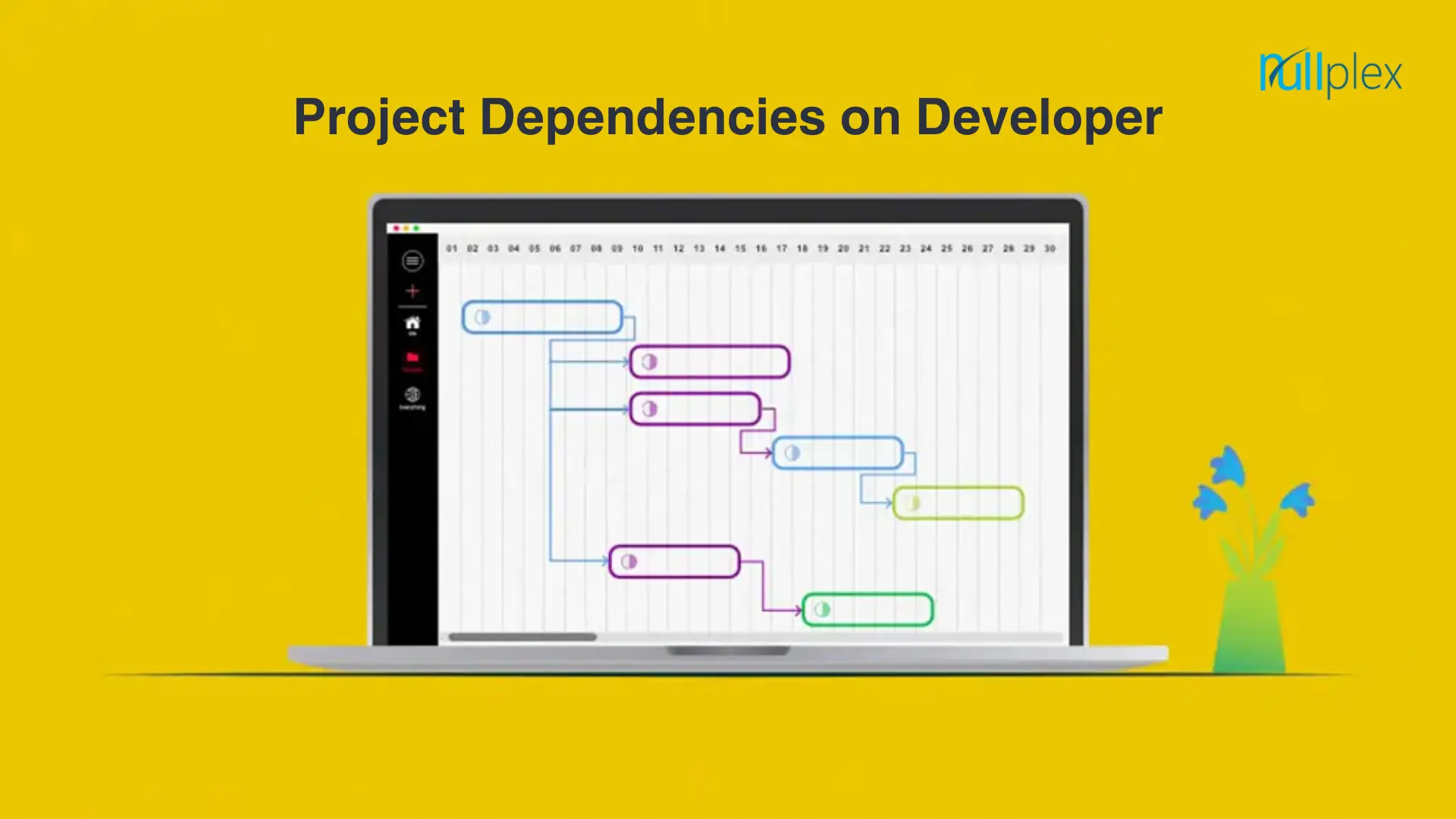
Developer Dependency: A Key Element in Project Execution

Project dependencies refer to the relationships between tasks or activities within a project, where the completion or timing of one task depends on the completion of another.

Types of Project Dependencies

  1. Logical dependencies

Logical or causal dependencies are quintessential to project management and cannot be avoided as they are necessary for project completion.

Tasks with logical dependencies cannot be performed simultaneously. Without completing a preceding task, the succeeding task cannot be started.

Example – You cannot publish a blog on your website straight away. It has to be written, reviewed, and edited before it is ready to be published.

  1. Cross-team dependencies

Cross-team dependencies are commonly witnessed in large-scale organizations where teams from different departments work together to complete a single complex project. In this case, teams depend on each other to achieve a common goal i.e. timely project completion and delivery.

  1. Discretionary dependencies

Discretionary dependencies, also known as preferred or soft logic dependencies, are those that are at the discretion of project teams, other stakeholders, and best industrial practices. These are not necessary for project completion but can help improve the quality of project deliverables.

  1. Internal dependencies

Internal project dependencies are those that project teams have complete control over and there’s no dependence on outside parties. Internal dependencies are when two tasks or activities within the same project are dependent on each other and there’s no reference to external projects and activities.

Example – The Quality Analyst team is not in a position to test software until the development process is finished.

  1. External dependencies

Opposite to internal dependencies, external dependencies are those when project teams have no control over external factors and are not in a position to do anything to escalate the project’s progress.

Although most project activities are controlled by internal teams. Many external factors can affect the progress of the projects such as client approval, vendors, tools, and others.

Example – A project team cannot start working on a project until the client (external party) gives the go-ahead to the team. In this case, a project team is dependent on external parties i.e. client to start working on a project.

Task dependencies in project management :

Finish to Start (FtS)

This task dependency is the most prevalent. Task A must be finished before Task B can begin.

Finish to Finish (FtF)

Before Task A is finished, Task B cannot be finished. This frequently occurs with tasks that have subtasks.

Start to Start (StS)

Task B cannot begin until Task A begins under this model. These are for tasks that need to be completed concurrently.

Start to Finish (StF)

For Task A to be finished, Task B must begin. This is crucial in circumstances where there must be overlap.

Conclusion :

Also, weekly assigned tasks will make it easier for the reviewing party to provide feedback in a more timely manner.

Weekly goals will help you focus on little portions of the projects, minuscule tasks that can be mapped out beforehand according to their urgency and priority.

These goals will help the team focus more on the task at hand. Therefore, there is no chance that they would get overwhelmed by the pressure of the upcoming tasks.

Why Developers and Testers Must Be Active Participants in Understanding the Project Scope?

Introduction: 

In any software development lifecycle, the success of a project depends not just on effective project management but on the active involvement of the entire team. Among the key players, developers and testers play crucial roles. However, their technical skills alone aren’t enough. Their willingness to dive deep into the project scope and actively contribute beyond the surface level is equally critical. But how important is it for them to fully understand the project scope, and what level of engagement is expected? 

  1. Understanding the Project Scope: A Foundation for Success

Developers and testers are at the forefront of creating and validating software. If they are unclear about the project’s goals, end-user needs, or key deliverables, they are more likely to introduce errors or miss essential aspects during development or testing. By having a deep understanding of the project scope, they align their work with the bigger picture, ensuring the product meets the business objectives and satisfies customer expectations. 

  1. Bridging the Communication Gap

Active involvement by developers and testers in understanding the project scope fosters better communication across teams. Misunderstandings between technical teams and stakeholders often arise when there’s a lack of clarity on what the project aims to achieve. Developers and testers who seek to fully grasp the scope can ask the right questions, clarify ambiguities, and avoid working in silos. 

  1. Preventing Bugs and Rework: Why Proactivity Matters

When developers and testers understand the scope thoroughly, they can foresee potential issues early, address edge cases proactively, and avoid unnecessary rework. This leads to more efficient project delivery with fewer bugs and changes needed later in the cycle. Developers with a complete grasp of the scope are able to write cleaner, more relevant code, while testers can design more comprehensive test cases, covering all critical paths. 

  1. Willingness to Learn and Adapt: The Key to Continuous Improvement

An essential trait for developers and testers is their willingness to constantly learn and adapt. Project scopes evolve, sometimes due to changing customer needs or market dynamics. Teams that are flexible and have a mindset of continuous learning can adapt faster to these changes, improving overall project agility. Proactive developers and testers should show a strong willingness to ask questions, challenge assumptions, and contribute ideas, thus adding value to the project. 

  1. Collaboration is Key

A project’s success hinges on collaboration between project managers, developers, testers, and other stakeholders. Developers and testers who actively participate in scoping discussions can offer valuable technical insights, foresee challenges, and propose solutions that may not have been obvious to non-technical team members. Collaboration builds a stronger, more cohesive team and leads to better decision-making. 

Conclusion: 

In today’s fast-paced development environment, the active engagement of developers and testers in understanding the project scope cannot be overstated. Beyond their technical roles, their willingness to dive into the scope, contribute ideas, and stay proactive are essential ingredients for delivering a successful project. Encouraging this mindset will result in fewer misunderstandings, reduced rework, and a smoother development process.

Career Hire Us
Request Callback

Got An Idea?

Let’s Build It.

Tell us what you need, and our team will guide you from concept to launch with clarity, speed, and expert care.